Circadia
My roles on the project include game designer and level designer. For game design, I worked in cooperation with the Programming team in order to ideate and iterate on game mechanics, gameplay sequences, and player interactions, ranging from platforming, puzzles, chases, and USPs.


We began the game design by producing a design document to showcase the idea and goals of the game. We then outlined the design pillars of the game which are:
-
Shifting Environment Puzzles
-
Contrasting Visuals
-
Phycological Reality Narrative
-
Linear
-
Atmospheric Horror
-
We then moved onto concepting potential mechanics for the game, the main one being Reality shifting wherein the player would switch between the 2 states of the world. Initially, this mechanic was in control of the player, but later in development, this got switched to automatic, occurring once the player passes through triggers to start and end it. The aim of this change was to make the game harder and the level design easier to produce as we only had to think of the alternate reality level when we would put the player in it instead of for the entire level.
I then went and concepted some puzzle / gameplay segments with a member from each discipline. This allowed the creation of these segment concepts to be within the realm of possibilities for each discipline. Due to time constraints with the project, only a handful of these segments / puzzles / interactions were produced, so the document houses a whole bunch of segments and interactions that never made it into the final version.
With the segments, puzzles, and mechanics now planned, we were able to be begin producing level design documents to include the gameplay we had planned.
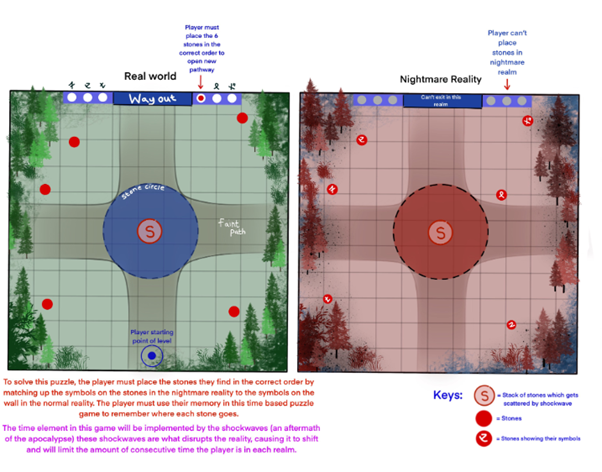
I began the level design process by working with the art team to produce a map of the starting area of the game as well as the first puzzle.
The core gameplay mechanic was the ability to switch between 2 states. One state would present threats and the other would be safe.
This led to the design having to revolve around 2 states of the same area, which allowed for some unique gameplay segments.
The level maps shown to the right show the progression of the level design as the game progressed, expanding the level, changing lacklustre segments, and incorporating more mechanics as they were produced.
The dependency chat shows the linear progression and the segments included in the final version of the game.



This was my first project in Unreal, so it took me a bit of time to figure out how to use it.
Once I got my bearings, I began to create a whitebox of the level, which became the basis of the game until I learnt the landscape tool, replacing the whitebox with 1 landscape object.
I used sketches on drawings to show my ideas and get feedback on them so that the team knew what I was making. After many iterations of the level, I got it to its final state where the gameplay had shifted more from puzzles to challenges.
The team used various agile practices while working on the game. We used a taskboard to ensure that everyone was up-to-date on what work was being done and what needed doing. We also performed daily scrum standups which allowed everyone to communicate what they had worked on and any concerns they had.

Screenshot shows the taskboard at the end of the project
Screenshot shows the taskboard at the end of the project
