Co-Operation
I worked on Co-Operation with a fellow designer. Our job was to create a design document, a prototype, numerous whiteboxes, and fully produce multiple levels for the game.
The main idea of the game is that 2 players would have 2 unqiue movesets and would have to work together in order to proceed through the levels to complete the operation. Essentially 1 player does something, then the other player can do their thing, Co-Operation.
The game would also feature bonus collectibles (Cores and Cosmic Ducks), which were heavily inspired by Studs and Minikits featured in TT Games's Lego games. Collecting a threshold of Cores would give the player a bonus ability like a dash or double jump, and Cosmic Ducks were there as a fun collectible to find throughout levels.
We began the project by creating a design document, where me and the other designer would note the required work from the other professions, the design pillars (co-op, slapstick, stealth), and character classes.


Initially the game would've allowed the players to choose between 3 characters per player, one being a brute and the other being a stealth class. To prevent scoping problems later, we chose to make the strongest pairing of classes first (The Hippo and The Scoundrel), that way we would be able to make a complete game with just 2 classes instead of minimal interactions with 6.
The Hippo would be the brute, able to destroy damaged objects, utilise a stronger attack, lift open certain doors, and pickup and throw the other player over walls and at enemies to instant kill.
The Scoundrel would be the stealth, using gadgets to activate fuseboxes which have a variety of uses, use a projectile to attack enemies, and stun enemies with a mine.
Later in development, we got feedback that Scoundrel was slow and not as engaging as Hippo, so we tweaked the moveset to combine the stun and projectile into one and create a new launch function that would propel the players high into the air. This lead to level tweaks to include this new feature later on.
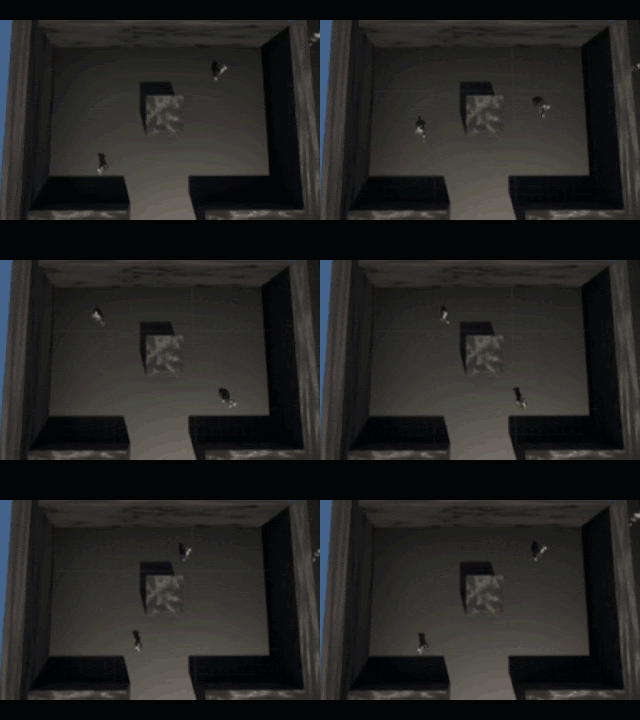
During the prototype stage of development, the game was initially designed around a top-down, slightly angled perspective. This would allow players to watch and learn enemy patrol routes and get an understanding of the level layout before moving. From feedback we got once we released the prototype, it was clear to us that the top-down perspective was not a good decision for this game as players had a hard time seeing their characters and figuring out what their unique interactions were / where they were in the level. We opted to keep the mechanics the same, but change the perspective to over the shoulder 3rd person with split screen.
I began official development by concepting 3 potential level layouts, allowing my team to vote for the favourite. All layouts follow the same stage structure, wherein there would be a cohesive theme across all 4 rooms of a stage, allowing for it to feel like the players were progressing when they noticed the environment change.
Layout 1 (the winner)
-
Players move horizontal from room to room
-
Realistic layout
-
Cohesive feeling
Layout 2
-
Players move vertical from room to room
-
Descension based
-
No on floor cohesiveness
Layout 3
-
Players move horizontal and vertical from room to room
-
Mixture of realistic layouts and descension drops
-
A mix of cohesive and not

With the level layouts locked in as Layout 1, I then wanted to experiment with what's actually in each room. Making 4 big rooms for every level seemed a bit dull, so I made some more concepts to expand on how each "room" was presented. The main objective remained that each room would be a minute long.

Layout 1
-
4 rooms broken into smaller rooms
-
Each room features a contained challenge
-
Short and sweet
Layout 2
-
4 large rooms
-
Stealth oriented
-
Longer duration in a single space
Layout 3 (the winner)
-
Combination of 1 and 2
-
Mix of small and long gameplay
-
Challenges can extend to rooms in a segment
With the final map structure decided, I began to whitebox the level using the map shown in Layout 3. This became the example of what future levels of the game should be based on, with each room of the building having a designated theme before / while being made (eg computer room, cantina, office, supply closet).


Entire whiteboxed map for Level 1

On the whitebox itself, I labelled what I wanted each room to be so that the art team knew what the room's purpose was. To further showcase the theming of each room within my whitebox, I took screenshots of each room and drew on them to show what they would look like once decorated with assets. This gave the art team a clear depiction of my vision for the map, and allowed for the vision to be met once the assets were produced.
While I waited on art assets, I placed the interactables around the level that the programming team had produced so that the level would just need the assets placing once they were made and the blueprints updating.
Once the assets were made, I would place the assets around the level and ensure that everything worked accordingly.
Once I had finished the office level, I began to work on a new version of our tutorial stage. Initially, the artist had created the tutorial environment to showcase our assets in the prototype, with me and the other designer having planned the layout and had placed the interactions within it. I took on the role of producing the new tutorial area, which would cover more interactions and feature more engaging gameplay than the original while the other designed focused on Level 2.


The original layout of the tutorial at the top was from the prototype. I did not alter the Fire Escape as it was a polished segment.
My new design shown below it features more co-op interactions before the fire escape segment, and introduces the players to more mechanics.
Once the core gameplay area was implemented, I decided to massively expand on this area. I made the rooftops of the city explorable, with many collectibles scattered across them. This made the game feel more open and really allowed for some fun extra exploration.
During this, me and the other designer were concepting and iterating on various designs for more levels. I was in charge of the 3rd level (Security) which got scrapped due to lack of time to produce the art and ensure polish.
The other designer and I finalised layouts for the Servers and the Labs. They went on to produce whiteboxes for both levels, followed by producing the finalised versions of the levels with assistance polish from myself.


Image shows a scrapped level from the game. The level was cut due to time constraints as the art assets would not have been made on time.
By May 2025, Version 1.0 had been produced and we showcased the game to the public at Falmouth Games Expo 2025.
This is where we got some very useful feedback on the game which helped us tweak various aspects for the 1.1 update.


With 1.1 introducing the new Scoundrel propel mechanic, some areas were tweaked to prevent the player from skipping the gameplay and other areas had entire gameplay segments altered to incorporate the propel so it felt like a natural and included part of the game.
This ultimately led to a redesign of the sub area in the Office level. The original area was about avoiding enemy chairs as Scoundrel to open doors for the Hippo in a different area. This was tweaked to be vertical, so Scoundrel would have to use the propel mechanic to scale up to the exit while avoiding the chairs.

This is what the taskboard was like at the end of development

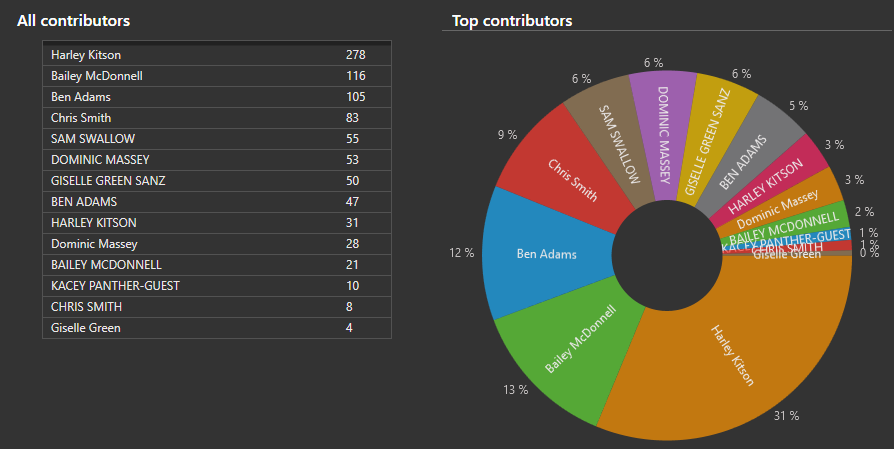
This is what the taskboard was like at the end of development
The team used various agile practices while working on the game. We used a taskboard and daily stand-ups to ensure that everyone was up-to-date on work status, as well as github version control.
