Level Under Construction
Level Under Construction is a 1st person platformer game wherein the player somehow enters a game that's early in development. Lucky for them, the Level Designer finds you and builds you some levels on the fly. Fair warning though, he hasn't play tested them and has a very fragile ego.
This project was made for the Make Us Laugh troll game competition, wherein the goal is to make the player laugh. Due to the time constraints of a competition and it being primarily focused on level design, I used the mechanics of my other project, Reality's Edge (programming by Ben Adams) as a base to build my levels around, utilising the wall run and grapple hook mechanics. This project was planned and fully constructed within 11 days.
We began the project by defining our design pillars which were:
-
Whitebox visuals - simple and conveys the theme of development - makes up for lack of art team on the project.
-
Linear - Linear level progression across numerous stages
-
Comedy - the goal is to make the player laugh. This can be done via a mix of sfx and occurrences in game
-
Narrative Progression - an audio narrative will follow the players through the level, providing jokes and forwarding the gameplay
With all that planned, I began by preparing the narrative of each level and creating various designs for segments and traps.

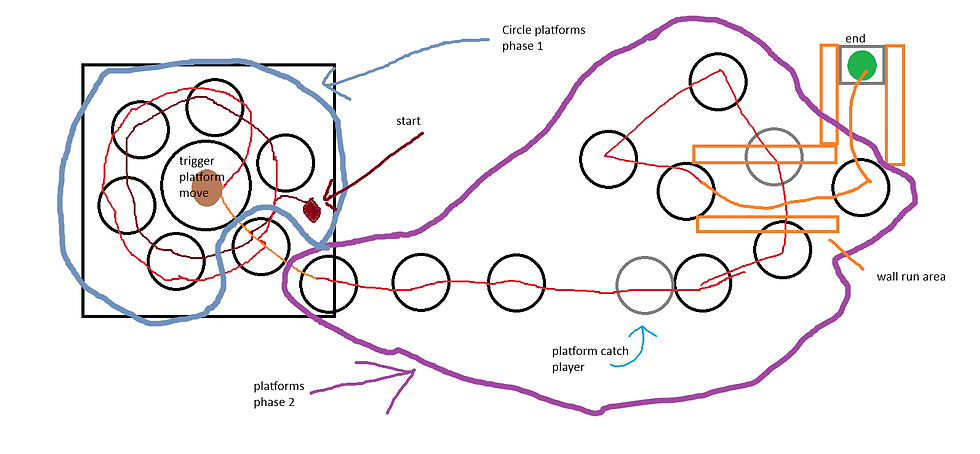


Shown to the left are the layout plans for the various stages.
Level 1: short and simple: focused more on setting up the narrative and sprinkling in minor jokes (eg moving the end of the stage, and having unmakeable jumps to joke with the player).
Level 2: More of a level, focusing on teaching the grapple, expanding on wall runs, and preparing the player for more trolls while solving a simple puzzle (eg moving platforms, spikes, moving the goal).
Sets up the narrative for the final level to be created.
Level 3: Tests the skills and memory of the player through 3 core segments split by checkpoints., combing skilled gameplay, quips, and traps / trolls. The end winds down the narrative and ends the story of the game.
I then went on to produce the levels in Unreal. I began by clocking out the environments and placing all of the objects that I wanted to be featured in each level before going on to implement their interactions. This allowed me to ensure that the actual level layout after each sequence would be possible.
After developing each of these, I had created each sequence for every interaction / segment that I had planned (eg moving platforms, spikes, spike pendulums, and many more).
I then encountered a major problem: resetting sequences on death. If they didn't reset, then the level would get easier after every loss, losing a core aspect of the "troll" game idea. Now, the easiest solution would be to reload the level, however, doing this would re-loop music tracks and wouldn't operate with the checkpoint system. This meant it had to somehow be attached to the player death system. Since Ben created the code for the player, I decided to go to him. He told me how to identify the player's death in the level blueprint, allowing me to trigger an custom event to reset a sequence. While this was a great starting point, this only told me how to reset a single sequence at a time. After looking at how his event worked, I realised that I could create a subsequent event for each sequence to reset, attaching that event to the death event. This way, any event I wanted resetting would reset as long as it was attached to this death event.
It's at this point that I also recognised a chance for some slight optimisation. Since there were 2 checkpoints in the level, the events preceding the checkpoint wouldn't need to be reset as the player won't go back through them, and any sequences beyond the player's current checkpoint don't need to be reset either since the player is no where near them. So, I created some Boolean variables to check whether a checkpoint has been reached, which would alter the array of sequences that would be reset.
